Cheese making machines are specialized pieces of equipment used to transform milk into cheese through controlled processing, separation, shaping, and maturation.
They are used in small dairy facilities, commercial cheese plants, and large food manufacturing operations. Depending on the type of cheese and production capacity, a facility may use milk storage tanks, pasteurization systems, cheese vats, curd cutters, draining equipment, presses, and refrigeration units.
Cheese production begins with milk preparation, followed by the addition of suitable cultures and, where required, rennet, an enzyme that helps milk form a gel. The resulting curd is cut to release whey, the liquid remaining after curd formation. The curd is then processed according to the cheese variety, which may involve heating, stirring, draining, pressing, salting, and maturation.
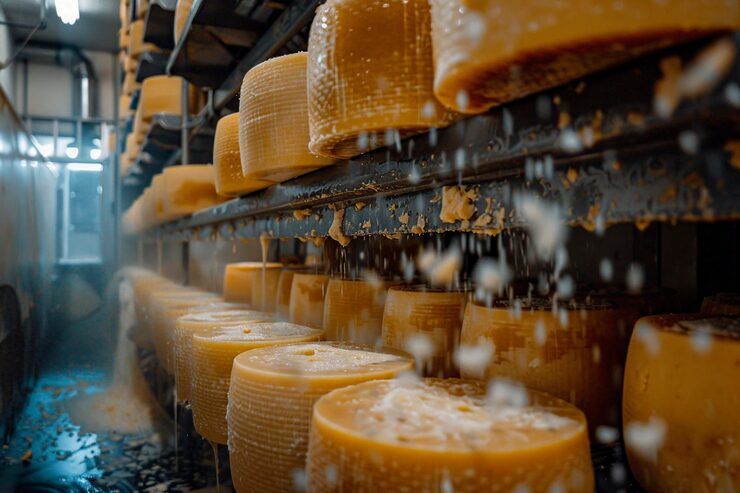
Industrial cheese making machines help maintain consistent processing conditions, reduce unnecessary manual handling, and support repeatable production. Their design varies according to the product being made. Soft cheeses, fresh cheeses, cheddar, mozzarella, and hard cheeses require different combinations of temperature control, curd handling, moisture management, and maturation equipment.
Importance
Why Industrial Cheese Making Equipment Matters
Industrial cheese production depends on controlling several variables, including milk composition, temperature, acidity, processing time, moisture, and microbial activity. Equipment helps operators manage these variables more consistently than an entirely manual process, particularly when production volumes are high.
Appropriate machinery can improve production efficiency, reduce material losses, and support traceability. Automated temperature sensors, programmable controls, and recorded processing data can also help operators identify deviations before they affect an entire batch.
However, automation does not guarantee product quality or food safety. Equipment must be correctly installed, operated, maintained, and cleaned. Staff training, laboratory testing, ingredient quality, and documented production procedures remain essential.
Common Types of Cheese Making Machines
Different stages of cheese production require specific equipment. A typical industrial facility may use the following systems.
| Equipment | Main function | Common application |
|---|---|---|
| Milk storage tanks | Hold milk under controlled conditions | Raw milk storage and processing preparation |
| Pasteurization systems | Apply a validated heat treatment to milk | Cheese varieties requiring pasteurized milk |
| Cheese vats | Support milk coagulation and curd processing | Fresh, soft, and hard cheese production |
| Curd cutters | Divide the curd into smaller pieces | Controlling whey release and curd size |
| Curd stirring and heating systems | Mix curds and regulate processing temperature | Cheddar, mozzarella, and other varieties |
| Whey separation equipment | Separate curds from whey | Multiple cheese production processes |
| Cheese presses | Apply pressure to remove additional whey and shape curds | Pressed and hard cheeses |
| Moulding and filling systems | Shape or portion cheese | Blocks, wheels, and formed products |
| Brining tanks | Apply salt through controlled immersion | Cheeses that use brine salting |
| Refrigeration and maturation rooms | Maintain suitable storage and ripening conditions | Aged cheese production |
| Cleaning-in-place systems | Clean compatible equipment internally without complete dismantling | Tanks, pipelines, and processing circuits |
The equipment configuration depends on the cheese variety, batch size, required production rate, and available facility space. A small operation may use multipurpose vats, while a large plant may use interconnected processing lines with automated controls.
How Cheese Making Machines Work Together
Industrial cheese production generally follows a sequence of interconnected operations.
- Milk reception and preparation: Milk is received, inspected, filtered where appropriate, and stored under suitable conditions.
- Heat treatment: Where required, milk passes through a validated pasteurization process.
- Coagulation: Cultures and coagulating agents are added according to the recipe and product specifications.
- Curd cutting and processing: The curd is cut, stirred, and sometimes heated to encourage whey separation.
- Draining and shaping: Whey is removed, and the curd is transferred into moulds or other forming equipment.
- Salting and pressing: Depending on the variety, cheese may be salted directly, immersed in brine, or pressed into shape.
- Cooling and maturation: Fresh products are cooled for storage, while ripened cheeses are held under controlled conditions.
Not every cheese follows every step. Fresh cheeses may be ready for packaging without extended maturation, whereas aged varieties require carefully controlled ripening environments.
Factors to Consider When Selecting Equipment
Selecting cheese manufacturing equipment requires more than comparing production capacity. The equipment must match the product, facility, hygiene requirements, and expected operating conditions.
Important considerations include:
- Production capacity: Determine the volume of milk processed per batch or production shift.
- Product type: Consider whether the plant produces soft, fresh, semi-hard, hard, or stretched-curd cheese.
- Material compatibility: Product-contact surfaces should use suitable food-contact materials that resist corrosion and can be cleaned effectively.
- Temperature control: Reliable sensors and control systems help maintain the required processing conditions.
- Automation: Automated controls can reduce repetitive manual tasks, but operators still need appropriate training.
- Cleaning access: Equipment should minimize residue accumulation and allow effective inspection and cleaning.
- Maintenance and traceability: Replacement parts, maintenance records, calibration, and batch documentation should be considered during equipment selection.
A machine that performs well for one cheese variety may not be appropriate for another. Equipment selection should therefore follow a review of the production process rather than capacity alone.
Recent Updates
Automation and Digital Process Monitoring
During the 12 months preceding October 13, 2026, the broader food-processing sector continued to develop digital monitoring, automated controls, and data-based production management. These technologies are relevant to cheese plants because small changes in temperature, acidity, timing, and moisture can affect the finished product.
Modern processing systems can use sensors and programmable logic controllers (PLCs) to regulate heating, mixing, pumping, and other operations. Digital records may help operators review processing conditions, investigate deviations, and improve consistency between batches.
These are general technology developments, not evidence of a particular cheese-machine announcement in 2026. No specific recent equipment launch or regulatory change is established here. Claims about adoption rates, productivity improvements, or industry growth would require current, reliable supporting data.
Hygiene-Focused Equipment Design
Hygienic design remains a central consideration in food-processing machinery. Equipment with suitable product-contact surfaces, accessible inspection points, effective drainage, and properly designed connections can help reduce the accumulation of milk residues and microorganisms.
Cleaning-in-place systems are especially useful for compatible tanks and pipelines because they circulate cleaning solutions through equipment with limited dismantling. Their effectiveness depends on validated procedures, including suitable chemical concentration, temperature, contact time, and flow conditions.
Automation can support hygiene management, but it cannot replace verification. Facilities still need to inspect equipment, confirm cleaning effectiveness, maintain records, and respond to microbiological or chemical residues when detected.
Laws or Policies
Food Safety Regulations in India
Cheese manufacturing facilities in India must follow applicable food safety requirements established under the Food Safety and Standards Act, 2006, and relevant regulations administered by the Food Safety and Standards Authority of India (FSSAI).
FSSAI's licensing and registration framework includes hygiene and sanitation requirements under Schedule 4 of the Food Safety and Standards (Licensing and Registration of Food Businesses) Regulations, 2011. Part III specifically addresses milk and milk products, making it particularly relevant to cheese manufacturing facilities.
Depending on the facility and its activities, operators may need to maintain appropriate documentation, implement a food safety management system, control contamination risks, and comply with applicable licensing conditions. Requirements should be checked against the current regulations and the facility's specific operations.
Hygiene Standards and Equipment Design
Industrial cheese making equipment should be designed and maintained to support hygienic food processing. Product-contact surfaces need suitable food-grade materials that resist corrosion and allow effective cleaning. Stainless steel is commonly used for this purpose, although the appropriate material depends on the equipment's application and specifications.
Important hygiene considerations include:
- Preventing milk residues from accumulating in inaccessible areas.
- Separating raw milk handling from areas used for processed products.
- Providing suitable handwashing facilities and staff hygiene procedures.
- Using potable water for applicable food-processing operations.
- Maintaining cleaning, sanitation, pest-control, and equipment inspection records.
- Calibrating temperature sensors and other instruments used for food safety monitoring.
FSSAI's dairy-sector guidance and inspection materials describe practical hygiene controls for milk and milk product processing. The Codex Alimentarius Code of Hygienic Practice for Milk and Milk Products also provides internationally recognized guidance. Codex guidance is not automatically a substitute for Indian law; its legal status depends on the applicable national requirements.
Tools and Resources
Several official and specialist resources can help dairy operators evaluate equipment, establish hygiene procedures, and improve quality control.
Food Safety and Standards Authority of India (FSSAI)
FSSAI provides food safety regulations, dairy-sector guidance documents, licensing information, and inspection materials. Manufacturers can use these resources to understand the requirements relevant to cheese processing, sanitation, and food safety management.
Food Safety Compliance System (FoSCoS)
FoSCoS is the official platform used for relevant FSSAI licensing and registration activities. Dairy businesses can consult it to understand applicable licensing procedures and their regulatory obligations.
Codex Alimentarius
Developed through the FAO and WHO food standards system, Codex provides international food standards and codes of practice. Its guidance on milk and milk products can help manufacturers understand recognized approaches to dairy hygiene and food safety.
Temperature Monitoring Instruments
Calibrated temperature probes, data loggers, and digital monitoring systems help operators record processing and storage conditions. These instruments can support verification of heating, cooling, refrigeration, and maturation processes when used within an appropriate monitoring plan.
Food Microbiology Testing
Appropriately equipped laboratories can test milk, cheese, water, and environmental samples for relevant microbiological hazards and hygiene indicators. Testing requirements depend on the product, process, risk assessment, and applicable regulations.
Cleaning and Sanitation Records
Documented cleaning schedules, inspection checklists, and sanitation verification records help operators confirm that equipment has been cleaned according to established procedures. These records are especially useful for reviewing recurring problems and identifying areas that require corrective action.
FAQs
What machines are required for industrial cheese production?
A typical cheese plant may need milk storage tanks, pasteurization equipment where required, cheese vats, curd cutters, whey separation systems, moulds, presses, and refrigeration units. The exact configuration depends on the cheese variety, production volume, and manufacturing process.
Why is stainless steel commonly used in cheese making machines?
Suitable stainless steel provides a durable, corrosion-resistant surface that can be cleaned effectively. The specific grade should be selected according to the product-contact conditions, cleaning chemicals, temperature, and applicable hygiene requirements.
How does automation improve cheese manufacturing?
Automation helps regulate temperature, mixing, processing time, pumping, and other operations. It can improve consistency and recordkeeping, but it does not replace staff training, sanitation, equipment maintenance, or appropriate quality testing.
What hygiene requirements apply to cheese manufacturing in India?
Applicable FSSAI requirements cover food safety management, hygienic processing, sanitation, and other controls relevant to the facility. Dairy manufacturers should review the applicable licensing conditions and Schedule 4 requirements, particularly Part III for milk and milk products.
How is cheese quality controlled during production?
Quality control involves inspecting incoming milk, monitoring processing conditions, checking curd characteristics, measuring relevant acidity and moisture parameters, and assessing the finished product. Depending on the cheese and applicable requirements, manufacturers may also conduct microbiological testing, packaging inspections, and storage-condition checks.
Conclusion
Cheese making machines support the controlled processing of milk into different cheese varieties, from fresh products to aged cheeses. Selecting appropriate equipment, maintaining hygienic processing conditions, and monitoring critical production parameters help manufacturers achieve consistent quality and manage food safety risks. In India, compliance with applicable FSSAI regulations, documented sanitation procedures, equipment maintenance, and suitable quality testing are essential elements of responsible cheese manufacturing.