A rock drilling rig is a mechanical system that uses a drill bit and a controlled source of force to penetrate rock.
Depending on the design, the machine may use percussion, rotation, or a combination of both to break the rock and advance the borehole.
The rig usually includes a drilling mechanism, a mast or feed structure, a power source, drill rods or pipes, and a system for removing rock fragments from the hole. Some models are mounted on wheels or tracks, while others are installed on trucks, underground carriers, or stationary platforms.
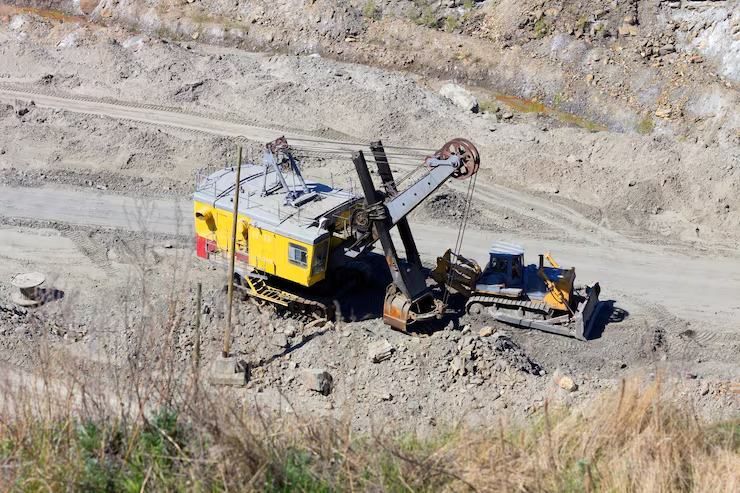
The selection of a drilling rig depends on rock hardness, drilling depth, borehole diameter, ground conditions, site accessibility, and the purpose of the hole.
How Does a Rock Drilling Rig Work?
The drilling process generally involves several connected operations.
- Positioning: The rig is moved to the required location and stabilized.
- Drill alignment: The mast and drill string are aligned with the intended borehole direction.
- Rock penetration: The drill bit breaks the rock through impact, rotation, or a combination of these actions.
- Cuttings removal: Air, water, or another suitable flushing method removes rock fragments from the borehole.
- Depth monitoring: Operators monitor drilling progress, pressure, rotation, and other operating conditions.
- Drill string withdrawal: The drill rods or pipes are removed when the required depth or drilling stage is reached.
The exact sequence varies by drilling method. Some rigs use continuous rotary drilling, while others repeatedly strike the rock with a percussion mechanism.
Main Components of a Rock Drilling Rig
| Component | Function |
|---|---|
| Drill bit | Breaks or cuts the rock formation |
| Drill rods or pipes | Transfer rotation, impact, or drilling force to the bit |
| Mast or feed beam | Supports and guides the drilling mechanism |
| Power system | Supplies energy to the drilling equipment |
| Rotation mechanism | Turns the drill string or bit |
| Percussion mechanism | Produces repeated impacts in suitable drilling systems |
| Flushing system | Removes rock fragments from the borehole |
| Control system | Regulates drilling movements and operating parameters |
| Carrier or chassis | Supports and transports the equipment |
Not every rig contains all these components in the same arrangement. Their design depends on whether the machine uses rotary, percussion, down-the-hole, or another drilling method.
Importance: Why Rock Drilling Rigs Matter
Mining and Mineral Exploration
Mining operations use drilling rigs to investigate geological formations, identify mineral-bearing zones, and prepare rock for excavation. Exploration drilling produces samples or other geological information that helps specialists understand the location and characteristics of underground deposits.
In surface mines and quarries, production drilling can prepare holes for controlled blasting where blasting is permitted and appropriate. The drilling pattern influences fragmentation, excavation efficiency, and the safety of nearby operations.
Construction and Infrastructure
Rock drilling is important in projects involving foundations, bridges, highways, dams, and retaining structures. Engineers may require boreholes to investigate subsurface conditions or install rock anchors and other ground-support systems.
In road construction, drilling rigs may also be used where hard rock must be fractured or removed. The equipment and drilling method depend on the geological conditions and the project's engineering requirements.
Tunneling and Underground Work
Underground drilling equipment is used to create blast holes, investigate geological conditions, install support systems, and prepare openings in rock. Compact drilling rigs can operate in confined spaces where larger surface machines cannot enter.
Underground applications require particular attention to ventilation, dust suppression, equipment dimensions, ground stability, and emergency access.
Water and Geothermal Projects
Some drilling rigs create boreholes for groundwater investigations, water wells, and geothermal systems. These applications may require deep drilling, accurate borehole alignment, and equipment designed to handle changing geological layers.
Water-well and geothermal drilling can involve methods different from those used in hard-rock mining. Therefore, a rig designed for production blast holes may not be appropriate for a deep water or geothermal borehole.
Types of Rock Drilling Rigs
Surface Drilling Rigs
Surface rigs are designed for drilling from ground level. They are widely used in quarries, open-pit mines, road projects, and other outdoor operations.
Many surface rigs are mounted on tracked carriers to travel across uneven terrain. Their drilling assemblies may be configured for vertical, angled, or other required borehole orientations.
Underground Drilling Rigs
Underground rigs are designed to work inside mines, tunnels, and other restricted environments. They often have compact profiles, articulated carriers, and specialized booms that position the drilling unit.
Common applications include development drilling, production drilling, and installation of rock-support systems. The configuration depends on tunnel dimensions, drilling direction, and the surrounding rock conditions.
Rotary Drilling Rigs
Rotary rigs penetrate rock by rotating a drill bit against the formation. Some systems apply weight to the bit while circulating a drilling fluid or another medium to remove cuttings.
Rotary drilling is used in several applications, including exploration and certain deep-borehole projects. The required bit design, torque, rotation speed, and flushing method depend on the geology and drilling objective.
Top-Hammer Drilling Rigs
In top-hammer systems, the percussion mechanism is positioned near the feed structure, and impact energy travels through the drill string to the bit. Rotation and feed force help the bit break the rock effectively.
These rigs are commonly used in quarrying, construction, and mining operations where the drilling depth and rock conditions suit the method.
Down-the-Hole Drilling Rigs
Down-the-hole, or DTH, systems position a percussion hammer close to the drill bit. Compressed air commonly powers the hammer and helps remove cuttings from the borehole.
DTH drilling can be useful in hard-rock formations and in applications requiring relatively straight holes. Actual performance depends on hole diameter, depth, rock properties, air supply, and bit selection.
Core Drilling Rigs
Core drilling rigs recover cylindrical samples of rock known as cores. These samples help geologists and engineers examine rock layers, mineral content, fractures, and other geological characteristics.
Core drilling is widely used in mineral exploration, geotechnical investigations, and scientific studies. The core diameter and drilling method are selected according to the sampling requirements.
Recent Updates and Technology Trends
Automation and Remote Operation
Modern drilling systems increasingly incorporate automated rod handling, programmed drilling sequences, and remote-control capabilities. These features can reduce the amount of time workers spend close to moving machinery and may help improve operating consistency.
Automation levels vary widely. Some rigs automate selected functions, while advanced systems can coordinate multiple drilling steps with limited operator intervention. Human supervision remains important for changing ground conditions, equipment faults, and safety decisions.
Digital Monitoring and Data Analysis
Sensors can monitor drilling depth, rotation speed, pressure, vibration, penetration rate, and other operating parameters. Digital systems may record this information for performance analysis and maintenance planning.
For example, a sudden change in penetration rate may indicate a change in rock hardness, bit wear, or a drilling problem. Such signals require interpretation because the same measurement can have different causes under different conditions.
Electrification and Energy Efficiency
Electrically powered and hybrid equipment is attracting attention in mining and construction. Electric systems can reduce local exhaust emissions when they replace combustion-powered equipment, particularly in enclosed underground environments.
However, the environmental effect depends on the electricity source, battery production, equipment design, and operating conditions. Power availability, charging infrastructure, ventilation requirements, and maintenance arrangements must also be considered.
Predictive Maintenance
Condition-monitoring systems can track component wear and operating trends to help plan maintenance before a failure interrupts drilling. Monitoring may cover hydraulic systems, compressors, motors, bearings, and drilling tools.
Predictive maintenance depends on reliable sensor data and suitable analysis. It complements, rather than eliminates, scheduled inspections and manufacturer-recommended maintenance.
Laws, Policies, and Safety Standards
Workplace Safety in India
Rock drilling operations in India may be subject to mining regulations, occupational safety legislation, environmental requirements, and project-specific permissions. The relevant rules depend on whether the work takes place in a mine, quarry, construction site, tunnel, or another regulated location.
The Mines Act, 1952, the Mines Rules, 1955, and the Metalliferous Mines Regulations, 1961 have historically formed part of India's mining safety framework. The Occupational Safety, Health and Working Conditions Code, 2020 is also relevant to the country's broader occupational safety legislation. The current applicability of particular provisions depends on commencement notifications, implementing rules, and the nature of the operation.
Operators should verify the latest requirements with the appropriate authorities, including the Directorate General of Mines Safety where applicable.
Environmental and Site Requirements
Drilling can generate dust, noise, vibration, and waste material. Projects may need to follow applicable environmental permissions, dust-control requirements, groundwater protections, and local restrictions.
Depending on the location and activity, additional permissions may be required for mining, blasting, water extraction, or work near protected areas and existing infrastructure.
Essential Safety Measures
Safe drilling requires coordinated controls for machinery, personnel, and surrounding ground conditions.
- Inspect drill rods, bits, hoses, connections, and guards before operation.
- Stabilize the rig on suitable ground and follow the prescribed setup procedure.
- Keep personnel away from rotating drill strings and moving feed mechanisms.
- Control airborne dust using appropriate water suppression, extraction, or other approved methods.
- Use suitable hearing, eye, head, foot, and respiratory protection based on the risk assessment.
- Follow safe procedures for handling rods, changing bits, and clearing blockages.
- Apply energy-isolation procedures before maintenance.
- Monitor ground stability and follow site-specific emergency procedures.
Where blasting is involved, only authorized and appropriately trained personnel should handle the associated activities under the applicable rules.
Tools and Resources for Rock Drilling Operations
Drill Bits and Drill Strings
Drill bits are selected according to rock hardness, abrasiveness, borehole diameter, and drilling method. Common designs include button bits, roller-cone bits, and core bits.
Drill rods and pipes transfer the required force to the bit. Their dimensions, connections, strength, and compatibility must match the drilling system. Worn or damaged components can affect performance and create safety risks.
Compressors and Flushing Systems
Compressed air is used in many pneumatic and DTH drilling systems. It can power the downhole hammer and help remove rock fragments.
Other drilling methods may use water or drilling fluids for cooling, lubrication, or cuttings removal. The correct arrangement depends on the formation, equipment design, environmental conditions, and borehole requirements.
Geological Survey and Measurement Tools
Geological maps, site surveys, borehole logs, and geotechnical investigations help engineers understand ground conditions before drilling begins.
During drilling, depth measurements, borehole deviation tools, and sampling equipment may provide additional information. The choice of tools depends on whether the project is focused on exploration, construction, production drilling, or groundwater investigation.
Maintenance and Monitoring Systems
Digital maintenance records help track equipment inspections, drilling hours, consumable replacement, faults, and repairs.
Useful records include:
- Operating hours and drilling depth.
- Drill-bit condition and replacement history.
- Hydraulic and compressor performance.
- Fuel or electricity consumption.
- Safety inspections and maintenance findings.
- Borehole logs and drilling measurements.
These records help identify recurring issues and support more informed maintenance planning.
Factors to Consider When Selecting a Rock Drilling Rig
Selecting a rig requires an understanding of the drilling objective and the conditions at the site.
| Selection factor | Why it matters |
|---|---|
| Rock hardness and abrasiveness | Influences drilling method and bit selection |
| Required borehole depth | Determines the necessary feed and drill-string arrangement |
| Hole diameter | Affects bit type, power, and flushing requirements |
| Drilling direction | Determines mast positioning and alignment capabilities |
| Site accessibility | Influences carrier dimensions and mobility |
| Power availability | Determines the suitability of diesel, electric, hydraulic, or pneumatic systems |
| Ground stability | Affects rig positioning and operating safety |
| Dust and noise controls | Influence equipment configuration and site planning |
| Maintenance capability | Affects reliability and operational continuity |
| Operator training | Supports correct setup, control, and troubleshooting |
The rig should be matched to the actual geological and operational requirements. A machine designed for shallow construction holes may not be suitable for deep exploration, and a compact underground rig may not provide the reach or productivity needed for large surface drilling operations.
Frequently Asked Questions
What is the main purpose of a rock drilling rig?
A rock drilling rig creates holes in rock for mining, exploration, construction, tunneling, foundations, and other geological applications. The required hole size and depth depend on the purpose of the project.
What is the difference between top-hammer and DTH drilling?
Top-hammer systems generate impact energy near the feed mechanism and transmit it through the drill string. DTH systems place the percussion hammer close to the bit, allowing impact energy to be delivered near the rock surface being drilled.
Which rock drilling rig is used for mineral exploration?
Core drilling rigs are commonly used when geological samples are required. Other exploration rigs may use different drilling methods depending on the depth, rock formation, and information needed.
How does rock hardness affect drilling performance?
Hardness and abrasiveness influence penetration rate, bit wear, required power, and drilling method. Fractures, moisture, and changes in geological layers can also affect performance.
What maintenance do rock drilling rigs require?
Maintenance commonly includes inspecting drill rods and bits, checking hydraulic and pneumatic systems, servicing filters, examining hoses and connections, and following scheduled checks for the power system and safety equipment. Specific requirements depend on the rig design and operating conditions.
Conclusion
Rock drilling rigs are essential machines for projects that involve hard geological formations. Their use ranges from mineral exploration and quarrying to tunneling, foundation preparation, and groundwater investigations. Different drilling methods address different requirements, making it important to understand the geology, borehole specifications, site conditions, and equipment capabilities before selecting a system.
Advances in automation, digital monitoring, electrification, and predictive maintenance are changing how drilling operations are managed. Even with these developments, effective results depend on appropriate drill tools, skilled operators, regular maintenance, environmental controls, and strong safety practices.