
Industrial automation has transformed modern manufacturing by making production faster, more accurate, and highly efficient. At the center of this transformation are industrial sensors, which continuously monitor machines, equipment, and production environments. These devices collect critical data that helps manufacturers improve quality, enhance operational efficiency, and support intelligent decision-making.
Today, industrial sensors are widely used across manufacturing plants, processing facilities, energy systems, and smart factories. Combined with technologies such as the Industrial Internet of Things (IIoT), artificial intelligence, and advanced automation, they enable real-time monitoring and predictive maintenance while improving production reliability.
This guide explains how industrial sensors work, the different sensing technologies available, and their growing role in smart automation systems and industrial applications.
What Are Industrial Sensors?
Industrial sensors are electronic devices designed to detect, measure, and monitor physical or environmental conditions during manufacturing and industrial operations. They convert physical changes into digital or electrical signals that can be processed by control systems and automation software.
Unlike manual inspection methods, sensors provide continuous monitoring, allowing equipment to respond automatically to changing operating conditions.
A typical industrial sensing system includes several key components:
- Sensing element
- Signal processing unit
- Communication interface
- Control system
- Monitoring software
Together, these components provide accurate data that supports efficient production and process control.
Why Industrial Sensors Are Important
Modern manufacturing relies heavily on accurate information. Industrial sensors provide the real-time data needed to monitor equipment, improve production quality, and maintain safe operating conditions.
Instead of relying solely on manual inspections, manufacturers can monitor machines continuously and respond immediately when operating conditions change.
Some important advantages include:
- Continuous process monitoring
- Improved production accuracy
- Faster fault detection
- Better operational efficiency
These capabilities make industrial sensors an essential part of smart manufacturing environments.
Types of Industrial Sensors
Different industrial processes require different types of sensors depending on the information being measured.
1. Temperature Sensors
Temperature sensors monitor heat levels in industrial equipment and manufacturing processes.
They are widely used in furnaces, chemical processing plants, food manufacturing facilities, and pharmaceutical production where accurate temperature control is essential.
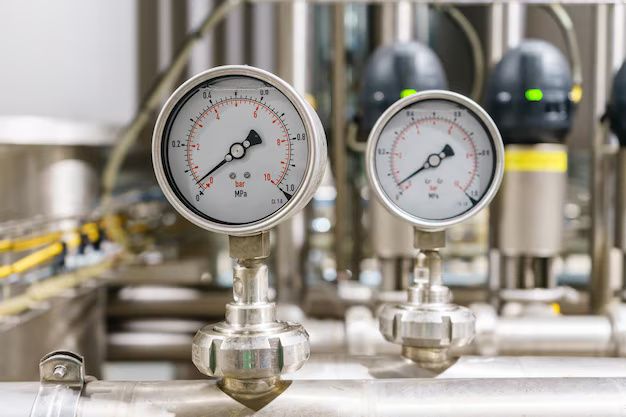
2. Pressure Sensors
Pressure sensors measure the force exerted by gases or liquids within industrial systems.
These sensors help monitor hydraulic equipment, pneumatic systems, pipelines, and manufacturing machinery to ensure stable operating conditions.
3. Proximity Sensors
Proximity sensors detect the presence or movement of objects without physical contact.
They are commonly installed on automated production lines to identify components, monitor product movement, and improve production efficiency.
4. Level Sensors
Level sensors measure the amount of liquid, powder, or bulk material inside tanks, silos, and storage systems.
These sensors help manufacturers manage inventory while supporting continuous production operations.
5. Flow Sensors
Flow sensors monitor the movement of liquids and gases through industrial systems.
They are frequently used in water treatment facilities, chemical manufacturing, and energy production to maintain consistent process performance.
How Industrial Sensors Work
Although sensor designs vary depending on their application, most follow a similar operating principle.
Detection
The sensing element detects changes in physical conditions such as temperature, pressure, position, vibration, or flow.
These changes are converted into measurable electrical signals.
Signal Processing
The generated signal passes through electronic circuits that improve accuracy and reduce interference.
This allows the sensor to provide reliable measurements even in demanding industrial environments.
Data Transmission
The processed information is transmitted to programmable logic controllers (PLCs), supervisory control systems, or industrial monitoring platforms.
Real-time communication enables immediate analysis and operational adjustments.
Automated Response
When connected to automation systems, sensors can trigger automatic actions such as adjusting machine settings, activating alarms, or stopping equipment if abnormal conditions are detected.
This helps improve both productivity and workplace safety.
Sensing Technologies Used in Industry
Industrial sensors use different technologies depending on the type of measurement required.
Optical Sensing
Optical sensors use light to detect objects, measure distances, or inspect product quality.
They are widely used in packaging, electronics manufacturing, and automated inspection systems.
Ultrasonic Sensing
Ultrasonic sensors measure distance and object position using high-frequency sound waves.
These sensors perform well in environments where non-contact measurement is important.
Magnetic Sensing
Magnetic sensors detect magnetic fields to monitor position, rotation, or movement.
They are commonly used in motors, conveyor systems, and industrial automation equipment.
Capacitive and Inductive Sensing
Capacitive sensors detect both metallic and non-metallic materials, while inductive sensors are designed primarily for metallic objects.
These technologies are widely used for object detection and automated positioning applications.
Smart Automation Systems
Industrial sensors play a central role in modern automation systems by providing continuous information that supports intelligent manufacturing.
Industrial Internet of Things
IIoT platforms connect sensors throughout the production facility, allowing operational data to be collected and analyzed in real time.
This connectivity improves visibility across manufacturing operations.
Artificial Intelligence
Artificial intelligence analyzes sensor data to identify trends, predict equipment behavior, and recommend operational improvements.
Machine learning systems become more accurate as additional production data becomes available.
Predictive Maintenance
Sensor data helps manufacturers identify early signs of equipment wear before failures occur.
This allows maintenance teams to schedule inspections and repairs based on equipment condition rather than fixed maintenance intervals.
Industrial Applications of Industrial Sensors
Industrial sensors are used across nearly every manufacturing sector because of their ability to improve monitoring and process control.
Manufacturing Industry
Manufacturing facilities use sensors to monitor machine performance, production quality, and equipment operating conditions.
Continuous monitoring helps improve efficiency while reducing unexpected production interruptions.
Automotive Manufacturing
Automotive production lines rely on sensors for robotic assembly, component positioning, quality inspection, and automated testing.
Accurate sensing contributes to consistent manufacturing quality.
Oil and Gas Industry
Oil and gas operations use industrial sensors to monitor pressure, temperature, flow rates, and equipment performance throughout production and distribution systems.
Continuous monitoring supports operational safety and system reliability.
Food and Beverage Processing
Food manufacturers use sensors to maintain precise environmental conditions during processing, packaging, and storage.
Accurate monitoring helps maintain consistent production standards while supporting product quality.
Benefits of Industrial Sensors
Industrial sensors provide numerous advantages that improve manufacturing performance and operational reliability.
Some key benefits include:
- Real-time monitoring
- Improved product quality
- Greater automation efficiency
- Better equipment reliability
These benefits allow manufacturers to optimize production while maintaining consistent operational performance.
Challenges in Sensor Implementation
Although industrial sensors provide significant advantages, successful implementation requires careful planning and integration.
Manufacturers must select sensors suitable for specific operating environments, maintain proper calibration, and ensure compatibility with existing automation systems.
Environmental conditions such as vibration, dust, moisture, and extreme temperatures may also influence sensor performance if appropriate equipment is not selected.
Regular maintenance and system testing help maintain measurement accuracy over long operating periods.
Future Trends in Industrial Sensors
Industrial sensing technology continues to advance alongside smart manufacturing and digital transformation.
Manufacturers are adopting intelligent sensors with built-in data processing, wireless communication, and self-diagnostic capabilities. Artificial intelligence and edge computing are also enabling faster analysis of sensor data directly within industrial equipment.
Future developments are expected to include greater integration with digital twin technology, autonomous manufacturing systems, and cloud-based industrial analytics platforms.
As Industry 4.0 continues to expand, industrial sensors will play an increasingly important role in creating connected, efficient, and intelligent manufacturing environments.
Conclusion
Industrial sensors have become a fundamental part of modern manufacturing by providing accurate, real-time information that supports automation, quality control, and operational efficiency. Through advanced sensing technologies, smart communication systems, and intelligent data analysis, these devices help manufacturers improve productivity while maintaining safe and reliable operations.
As industries continue embracing digital manufacturing, Industrial Internet of Things technologies, and artificial intelligence, industrial sensors will remain essential for building smarter factories and more efficient production systems. Their ongoing development will continue to shape the future of industrial automation across manufacturing, energy, transportation, healthcare, and many other sectors.