
Commercial refrigeration systems are designed to remove heat from enclosed spaces, products, or industrial processes to maintain specified temperatures. They are used in supermarkets, restaurants, food processing plants, warehouses, hospitals, laboratories, and other commercial facilities. These systems help preserve perishable goods, maintain controlled environments, and support operations that depend on reliable cooling.
Unlike ordinary household refrigerators, commercial refrigeration equipment is often designed for larger cooling loads, longer operating hours, frequent door openings, and demanding environmental conditions. Depending on the application, a system may consist of display cabinets, cold rooms, refrigerated storage units, compressors, condensers, evaporators, expansion devices, and electronic controls.
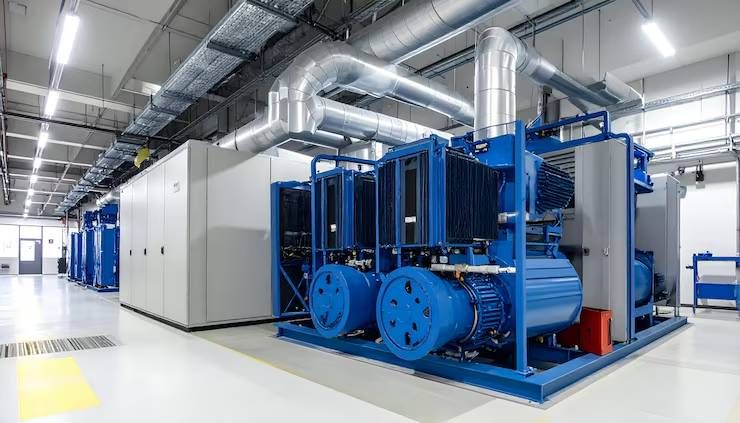
Commercial refrigeration is closely related to industrial cooling, but the two categories are not identical. Commercial systems commonly support food retail, hospitality, and commercial storage, while industrial refrigeration often serves large production facilities, chemical processes, and specialized manufacturing operations.
How commercial refrigeration works
Most commercial refrigeration systems operate through a refrigeration cycle that transfers heat from a colder area to a warmer surrounding environment. The system uses a refrigerant that circulates through several components and changes pressure and, in many systems, physical state.
The main stages are:
Evaporation: The refrigerant absorbs heat from the refrigerated space as it evaporates inside the evaporator.
Compression: The compressor raises the refrigerant's pressure and temperature.
Condensation: The condenser releases heat to the surrounding air or cooling water, allowing the refrigerant to condense.
Expansion: An expansion device reduces the refrigerant pressure, preparing it to absorb heat again.
This cycle repeats while cooling is required. Thermostats, temperature sensors, pressure controls, and electronic controllers regulate operation according to the system design and the required temperature range.
Main components of a commercial refrigeration system
Each component has a specific function within the cooling cycle.
Compressor: Circulates refrigerant and raises its pressure. Common compressor designs include reciprocating, scroll, screw, and centrifugal types, although not every type is suitable for every application.
Condenser: Rejects heat from the refrigerant to air or water. Air-cooled condensers are common in many commercial installations, while water-cooled designs are used in selected larger systems.
Evaporator: Absorbs heat from the refrigerated air, liquid, or process stream. Evaporators may be installed inside display cabinets, cold rooms, processing equipment, or other cooled spaces.
Expansion valve: Regulates refrigerant flow into the evaporator and creates the pressure reduction needed for the refrigeration cycle.
Refrigerant: Carries heat through the system. Refrigerant selection affects operating performance, equipment design, safety requirements, and environmental impact.
Control system: Monitors temperatures and other operating conditions, regulates equipment, and may trigger alarms when readings fall outside defined limits.
Types of Commercial Refrigeration Systems
Commercial refrigeration equipment is available in several configurations. The appropriate system depends on the space being cooled, the products being stored, the required temperature, the available installation area, and the expected operating conditions.
Reach-in refrigerators and freezers
Reach-in units are enclosed cabinets with doors that allow staff to access stored products. They are commonly used in restaurants, cafés, convenience stores, commercial kitchens, and small food preparation areas.
Refrigerators maintain temperatures above freezing for chilled products, while freezers operate at lower temperatures for frozen goods. Their performance depends on insulation, door seals, airflow, refrigerant controls, and the surrounding environment.
Walk-in cold rooms
Walk-in cold rooms are insulated enclosures designed for storing larger quantities of refrigerated or frozen products. They are used by supermarkets, food distributors, hotels, restaurants, and food processing facilities.
A typical installation includes insulated wall and ceiling panels, a refrigeration unit, evaporator fans, temperature controls, and appropriate doors. Larger installations may use remote condensing units or centralized refrigeration equipment.
Commercial display refrigeration
Display refrigerators and freezers are designed to keep products chilled or frozen while allowing customers or staff to view and access them. Common examples include refrigerated supermarket cases, beverage coolers, dairy displays, and frozen food cabinets.
Some systems use doors to limit the exchange of warm air, while others have open fronts with specially designed airflow arrangements. Door design, lighting, ambient temperature, and product loading can all affect energy consumption and temperature stability.
Centralized refrigeration systems
Centralized systems use shared refrigeration equipment to serve multiple display cases, cold rooms, or storage areas. They are often used in large supermarkets, distribution facilities, and commercial buildings with several cooling requirements.
These arrangements can simplify equipment coordination but require careful system design, refrigerant management, piping, controls, and maintenance planning.
Condensing units and packaged systems
A condensing unit generally combines a compressor, condenser, and associated components into an assembled unit. It works with compatible evaporators and controls to provide cooling for a designated space.
Packaged refrigeration systems integrate several components into a compact assembly. Their configuration varies according to the cooling capacity, installation requirements, and intended application.
Refrigeration Technologies and Refrigerants
Commercial refrigeration systems use different cooling technologies depending on the required temperature, capacity, environmental conditions, and operating requirements. Conventional vapor-compression refrigeration is widely used, while alternative technologies serve specialized applications.
Vapor-compression refrigeration
Vapor-compression technology is the standard approach in many commercial refrigerators, freezers, and cold rooms. It relies on the compressor, condenser, expansion device, and evaporator to transfer heat continuously.
System performance depends on factors such as the evaporating temperature, condensing temperature, compressor efficiency, heat-exchanger design, and refrigerant flow. Poor airflow, dirty condenser coils, or incorrect refrigerant charge can reduce performance and affect temperature control.
Refrigerants used in commercial refrigeration
Refrigerants are working fluids that absorb and release heat as they circulate through the refrigeration system. Their properties influence system efficiency, operating pressures, safety, and environmental effects.
Refrigerant | General characteristics | Common considerations |
|---|---|---|
R-744 (carbon dioxide) | Natural refrigerant with very low direct global warming potential | Operates at high pressures and requires specialized equipment |
R-290 (propane) | Natural refrigerant with favorable thermodynamic properties | Highly flammable; charge limits and safety precautions are important |
R-717 (ammonia) | Efficient refrigerant widely used in industrial refrigeration | Toxic and requires suitable engineering safeguards |
R-1234yf | Refrigerant with low global warming potential | Mildly flammable and used in selected refrigeration and cooling applications |
R-448A | Refrigerant blend used in certain commercial refrigeration systems | Retrofit suitability, operating conditions, and applicable regulations must be assessed |
The table provides general information rather than a complete equipment selection guide. Refrigerant compatibility depends on the compressor, lubricants, seals, piping, system design, and local safety requirements. Existing systems should not be converted to another refrigerant without a qualified technical assessment.
Temperature monitoring and control
Temperature control is essential in commercial refrigeration, especially where food safety, product quality, or laboratory conditions depend on maintaining a defined range.
Digital controllers can regulate compressor operation, evaporator fans, defrost cycles, and alarms. Larger facilities may use remote monitoring systems to record temperatures and notify staff when equipment operates outside configured limits.
Temperature records can help identify recurring problems, such as frequent door openings, poor airflow, evaporator icing, or equipment failures. Monitoring systems must be appropriately configured and maintained to provide useful information.
Manufacturing Processes and Industrial Applications
Commercial refrigeration equipment manufacturing combines mechanical fabrication, refrigeration engineering, electrical assembly, insulation technology, and testing. Manufacturing procedures vary according to whether the product is a display cabinet, cold-room assembly, condensing unit, or large centralized system.
How commercial refrigeration equipment is manufactured
Design and engineering: Engineers establish cooling capacity, temperature requirements, cabinet dimensions, insulation needs, refrigerant selection, and electrical specifications. Heat-load calculations account for the products, surrounding temperature, lighting, door openings, and other sources of heat.
Metal fabrication: Sheet metal is cut, formed, punched, and assembled to create cabinets, equipment housings, brackets, and structural supports. Appropriate surface treatments help protect components against corrosion.
Insulation and cabinet assembly: Insulating materials are installed within cabinet walls and doors or incorporated into insulated panels. Proper insulation and sealing reduce heat entering the refrigerated space.
Heat-exchanger production: Condensers and evaporators are manufactured using suitable tubes, fins, plates, or other heat-transfer structures. Assembly and joining methods depend on the material and design.
Refrigeration circuit assembly: Compressors, valves, filters, piping, and other components are installed and connected. Technicians follow procedures for joining pipes, preventing contamination, checking for leaks, and preparing the circuit for operation.
Electrical and control integration: Wiring, sensors, protection devices, controllers, and user interfaces are installed and checked. Control logic is configured to regulate temperatures and coordinate equipment operation.
Testing and quality checks: Manufacturers conduct appropriate inspections and functional tests. Depending on the product and applicable requirements, these may include leak testing, electrical safety checks, temperature performance evaluation, and verification of operating controls.
Industrial and commercial applications
Commercial refrigeration supports many activities where products or materials must remain within controlled temperature ranges.
Food retail: Supermarkets and grocery stores use refrigerated displays, freezers, and cold rooms for perishable products.
Hospitality: Restaurants, hotels, catering facilities, and commercial kitchens rely on refrigeration for ingredients and prepared food.
Food processing: Processing plants use chilled storage and refrigeration equipment to support production and temperature management.
Warehousing and distribution: Cold-storage facilities maintain conditions for products awaiting transport or distribution.
Pharmaceutical storage: Selected medicines and temperature-sensitive materials require controlled storage conditions according to their specifications.
Beverage production: Breweries, beverage plants, and distribution facilities use refrigeration during processing, storage, and temperature management.
Floral and specialty storage: Certain flowers, plants, and other temperature-sensitive products require refrigerated environments.
The required temperature varies by product and application. Refrigeration equipment must be matched to the relevant storage conditions, and cooling alone does not guarantee that stored goods remain safe or retain their intended quality.
Recent Developments in Commercial Refrigeration
Commercial refrigeration technology is evolving in response to energy-efficiency requirements, refrigerant regulations, digital monitoring, and the need to maintain reliable temperature control. Recent developments through 2024–2026 reflect greater attention to system performance across the full operating life of refrigeration equipment.
Energy-efficient cooling technologies
Manufacturers are developing and refining variable-speed compressors, electronically controlled expansion valves, improved heat exchangers, and more effective insulation. Variable-speed equipment can adjust its output to match changing cooling demand rather than operating continuously at one fixed capacity.
Heat recovery is another area of interest. Refrigeration systems reject heat through their condensers, and some installations capture part of this thermal energy for water heating or other suitable applications. Whether heat recovery is practical depends on the temperature requirements, operating schedule, and system configuration.
Natural refrigerants and environmental considerations
Natural refrigerants such as carbon dioxide, ammonia, and propane are used in different commercial and industrial applications. Their environmental characteristics and technical requirements vary, so refrigerant selection must account for safety, equipment design, local regulations, and operating conditions.
Regulatory changes affecting fluorinated greenhouse gases are also influencing equipment design and refrigerant choices in several markets. Manufacturers and facility operators must consider applicable phase-down schedules, restrictions, installation requirements, and maintenance rules rather than assuming one refrigerant is suitable for every system.
Smart refrigeration and predictive maintenance
Connected refrigeration controllers can record temperature, pressure, energy use, and equipment operating time. Remote monitoring platforms may provide alerts when a system experiences abnormal conditions or fails to maintain its configured temperature range.
Predictive maintenance techniques can help identify possible problems involving compressors, fans, sensors, and heat exchangers. However, automated alerts require appropriate interpretation, and regular inspection remains important.
Laws, Standards, and Safety Requirements
Commercial refrigeration is subject to requirements covering refrigerant handling, electrical safety, pressure equipment, food storage, workplace conditions, and environmental protection. The relevant rules depend on the country, system capacity, refrigerant type, and application.
Regulations in India
In India, commercial refrigeration installations may need to comply with applicable electrical safety requirements, building regulations, fire safety provisions, environmental rules, and occupational safety obligations. Facilities storing food must also consider the relevant food safety and hygiene requirements.
The Food Safety and Standards Authority of India (FSSAI) establishes requirements relevant to food businesses, including applicable hygiene and storage practices. Specific temperature controls depend on the food category and relevant regulatory guidance.
Refrigerants and refrigeration equipment may also be affected by India's obligations under the Montreal Protocol and related ozone-depleting substance controls. Requirements depend on the substance, equipment type, and applicable rules. Businesses should verify current obligations before installing, servicing, or replacing equipment.
International standards and technical guidance
Several technical standards and frameworks may be relevant to refrigeration equipment and installations.
ISO 5149: Addresses safety and environmental requirements for refrigeration systems and heat pumps.
ASHRAE standards: Cover various aspects of refrigeration, ventilation, indoor environmental conditions, and system safety.
IEC 60335-2-89: Addresses safety requirements for certain commercial refrigerating appliances.
HACCP principles: Help food businesses identify and manage hazards throughout food handling and storage processes.
Standards may be adopted into regulations or referenced in contracts, but they are not automatically legal requirements in every location. The applicable edition and local adoption should be confirmed for each installation.
Refrigerant and workplace safety
Refrigerant hazards differ according to toxicity, flammability, pressure, and the concentration that could accumulate after a leak. Equipment rooms and enclosed spaces may require appropriate ventilation, leak detection, emergency procedures, and access controls.
Only suitably trained personnel should undertake work involving refrigerant circuits, pressure-containing components, or electrical systems. Equipment documentation, leak checks, and maintenance records help support safe operation.
Tools and Resources
Commercial refrigeration systems require appropriate sizing, monitoring, maintenance, and documentation. Several categories of technical tools help facility operators and refrigeration engineers manage these tasks.
Common tools used in refrigeration management
Cooling load calculators: Estimate the heat that must be removed from a room or cabinet based on dimensions, insulation, ambient conditions, stored products, and door-opening frequency.
Temperature data loggers: Record temperature measurements over time to help verify storage conditions and identify fluctuations.
Refrigeration design software: Supports equipment selection, piping calculations, heat-transfer analysis, and system configuration.
Leak detection instruments: Help identify refrigerant leaks using methods suitable for the refrigerant and installation.
Energy monitoring systems: Track electricity consumption and operating patterns to help identify inefficient equipment operation.
Factors to consider when selecting a system
Factor | Importance |
|---|---|
Cooling capacity | Must match the expected heat load |
Temperature range | Depends on the products and intended application |
Refrigerant | Influences safety, efficiency, and environmental impact |
Insulation | Affects heat entering the refrigerated space |
Maintenance access | Supports inspection and equipment upkeep |
Monitoring controls | Help maintain temperature consistency |
Applicable regulations | Determine relevant safety and compliance requirements |
Frequently Asked Questions
What are commercial refrigeration systems used for?
They maintain controlled temperatures in supermarkets, restaurants, food warehouses, processing facilities, and other commercial environments. Applications include chilled storage, frozen storage, product display, and process cooling.
What is the difference between commercial and industrial refrigeration?
Commercial refrigeration commonly supports retail, hospitality, and commercial storage. Industrial refrigeration generally handles larger or specialized cooling requirements in manufacturing, chemical processing, and other industrial operations.
Which refrigerants are used in commercial refrigeration?
Common options include carbon dioxide, propane, ammonia in suitable industrial applications, and various synthetic refrigerants. Selection depends on system design, safety requirements, operating conditions, and applicable regulations.
How can commercial refrigeration energy consumption be reduced?
Suitable measures include maintaining condenser coils, checking door seals, improving insulation, maintaining correct airflow, and using appropriately configured controls. Variable-speed equipment and heat recovery may also help in suitable installations.
How often should commercial refrigeration systems be inspected?
Inspection frequency depends on equipment design, operating conditions, manufacturer instructions, safety requirements, and the products being stored. Temperature monitoring and scheduled maintenance help identify developing problems.
Conclusion
Commercial refrigeration systems support food storage, hospitality, distribution, manufacturing, and other temperature-sensitive operations. Their main technologies include vapor-compression cycles, different refrigeration equipment configurations, and a range of refrigerants. System performance depends on appropriate design, insulation,