The specialty chemicals industry plays an important role in modern manufacturing, technology, healthcare, agriculture, construction, electronics, automotive production, and many other sectors.
Unlike commodity chemicals, which are generally produced in large volumes for broad applications, specialty chemicals are often developed for specific performance characteristics and technical requirements.
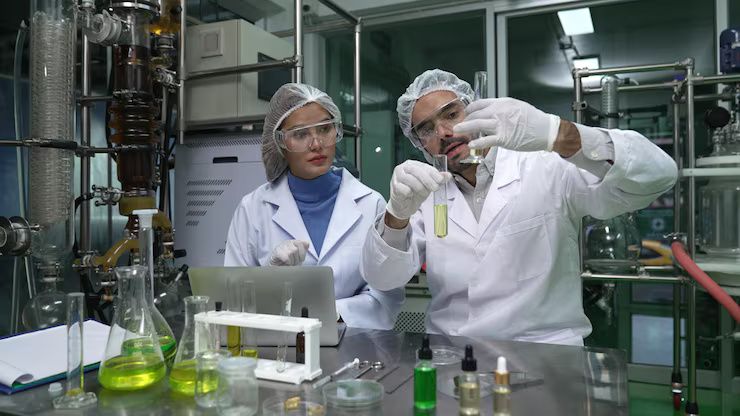
These chemicals may improve durability, enhance processing, protect surfaces, support product stability, or enable specialized industrial functions. Their development typically requires detailed research, careful formulation, controlled manufacturing, and rigorous quality control.
For businesses, researchers, engineers, and students seeking to understand the sector, it is useful to look beyond the final chemical product and examine the complete journey from research and development to manufacturing, testing, and application. This guide explores the structure of the Specialty Chemicals Industry, the role of Specialty Chemical Manufacturers and Specialty Chemical Suppliers, and the quality systems that help maintain consistent performance.
What Is the Specialty Chemicals Industry?
The Specialty Chemicals Industry focuses on chemicals designed to provide specific functions or performance benefits in targeted applications.
Examples can include:
- Adhesives and sealants
- Coatings and surface treatments
- Performance additives
- Electronic chemicals
- Water treatment chemicals
- Specialty polymers
- Construction chemicals
- Personal care ingredients
- Agricultural formulations
- Industrial processing chemicals
The value of these products often comes from their technical properties rather than the volume produced. A relatively small quantity of a specialized chemical may have a significant effect on the performance, durability, safety, or efficiency of a finished product.
How Specialty Chemicals Differ From Commodity Chemicals
Commodity chemicals are typically manufactured in large quantities and used as basic inputs across many industries. Specialty chemicals, by contrast, are usually formulated for particular applications and performance requirements.
The distinction can be understood through several characteristics.
| Factor | Commodity Chemicals | Specialty Chemicals |
|---|---|---|
| Production Volume | Generally high | Often lower |
| Application | Broad | Highly specific |
| Product Focus | Basic chemical properties | Functional performance |
| Research | Process-focused | Application and formulation-focused |
| Customer Requirements | Relatively standardized | Often highly customized |
| Quality Evaluation | Standard specifications | Detailed performance testing |
This difference means that specialty chemical development often involves close interaction between chemistry, engineering, application science, and quality management.
Research and Development in Specialty Chemicals
Research and development is central to the specialty chemicals sector. New products often begin with a specific technical challenge that requires a chemical solution.
Researchers may investigate:
- Molecular structures
- Raw material compatibility
- Formulation stability
- Thermal performance
- Chemical resistance
- Environmental characteristics
- Processing behavior
- Long-term durability
The research process may begin with laboratory experiments before progressing to pilot-scale production. At each stage, scientists evaluate whether the formulation delivers the desired characteristics consistently.
Modern research also increasingly considers environmental impact, resource efficiency, and safer chemical design.
Product Development and Formulation
Once a promising chemical concept is identified, development teams work to create a practical formulation.
Formulation involves selecting and combining components in carefully controlled proportions to achieve specific performance characteristics.
For example, a formulation may need to balance:
- Strength
- Flexibility
- Stability
- Viscosity
- Heat resistance
- Moisture resistance
- Shelf life
- Processing requirements
The final formulation must perform reliably under the conditions in which it will be used. This makes application testing an essential part of specialty chemical development.
The Role of Specialty Chemical Manufacturers
Specialty Chemical Manufacturers convert researched formulations into consistent commercial-scale products.
Their responsibilities may include:
- Raw material qualification
- Process development
- Production planning
- Batch manufacturing
- Equipment management
- Process monitoring
- Quality testing
- Packaging and labeling
- Regulatory documentation
Manufacturing specialty chemicals often requires precise process control because small variations in temperature, pressure, mixing, or reaction conditions can influence the final product.
For this reason, manufacturers typically use controlled production environments and documented procedures to maintain consistency between batches.
Specialty Chemical Suppliers and the Supply Chain
Specialty Chemical Suppliers play an important role in connecting manufacturers with industries that require specialized chemical inputs.
The supply chain may involve:
- Raw material producers
- Chemical manufacturers
- Specialty formulation companies
- Distributors
- Industrial users
- Research and development organizations
Efficient supply chain management is important because specialty chemical applications may depend on consistent raw material availability and predictable product specifications.
Suppliers may also provide technical documentation, handling information, application guidance, and regulatory information to support responsible chemical use.
Manufacturing Processes in the Specialty Chemicals Sector
Manufacturing processes vary significantly depending on the chemical and its intended application.
Common processes may include:
- Chemical synthesis
- Blending
- Mixing
- Polymerization
- Distillation
- Filtration
- Drying
- Granulation
- Encapsulation
Process selection depends on factors such as chemical properties, production scale, formulation requirements, and desired product characteristics.
Modern manufacturing facilities increasingly use automation and digital monitoring to improve process consistency and identify deviations quickly.
Quality Control and Quality Assurance
Quality control is one of the most important parts of specialty chemical manufacturing.
Because customers often rely on specific performance characteristics, even minor changes in product composition can affect the final application.
Quality control may involve testing:
- Chemical composition
- Purity
- Viscosity
- Density
- Moisture content
- Particle size
- Thermal stability
- Physical properties
- Performance characteristics
Quality assurance focuses on the broader systems used to prevent errors and maintain consistent processes. Together, quality control and quality assurance help ensure that products meet defined specifications.
Regulatory and Safety Considerations
Specialty chemicals must be developed and manufactured with appropriate attention to safety, environmental responsibility, and regulatory requirements.
Depending on the product and region, companies may need to manage:
- Chemical classification
- Product labeling
- Safety documentation
- Workplace exposure controls
- Transportation requirements
- Environmental regulations
- Waste management
- Product stewardship
Specialty Chemical Companies must maintain accurate documentation and ensure that employees understand appropriate handling and operational procedures.
Responsible chemical management also involves evaluating potential environmental impacts throughout the product lifecycle.
Sustainability in Specialty Chemicals
Sustainability has become an increasingly important consideration across the industry.
Specialty chemical companies are exploring ways to reduce environmental impact through:
- Lower-energy manufacturing processes
- Renewable or alternative raw materials
- Reduced waste generation
- Improved solvent recovery
- Water conservation
- Recyclable packaging
- More efficient formulations
Research and development teams are also investigating materials that provide high performance while requiring fewer resources.
The challenge is to balance technical performance, safety, environmental considerations, and practical manufacturing requirements.
Digital Transformation and Industry Technology
Digital technologies are changing how specialty chemicals are researched, produced, and monitored.
Emerging technologies include:
- Artificial intelligence for formulation research
- Machine learning for process optimization
- Internet of Things sensors
- Automated laboratory systems
- Predictive maintenance
- Digital quality management
- Data analytics
- Process simulation
These technologies can help researchers analyze complex data and identify relationships between chemical formulations and performance characteristics.
In manufacturing, real-time monitoring can help identify process variations and support faster decision-making.
Challenges Facing Specialty Chemical Companies
The industry faces several challenges that require continuous innovation.
Complex Research Requirements
Developing a specialty chemical often requires extensive laboratory testing and application-specific research.
Raw Material Availability
Changes in raw material availability can influence manufacturing schedules and supply chain stability.
Regulatory Complexity
Chemical regulations vary between regions, requiring careful documentation and compliance management.
Quality Consistency
Maintaining identical performance across production batches requires strict process control and testing.
Environmental Expectations
Companies increasingly need to reduce environmental impact while maintaining product performance.
These challenges encourage continued investment in research, manufacturing technology, and responsible chemical management.
Future Trends in the Specialty Chemicals Industry
Several developments are expected to influence the future direction of the sector.
These include:
- Bio-based chemical development
- Circular economy approaches
- Advanced polymer technologies
- Sustainable formulation strategies
- AI-assisted research
- Automated laboratories
- Digital manufacturing
- Improved recycling technologies
- More precise quality monitoring
As industries demand materials with increasingly specific performance characteristics, the Specialty Chemicals Industry is likely to remain strongly connected to innovation across manufacturing and technology sectors.
Frequently Asked Questions
What is the Specialty Chemicals Industry?
The Specialty Chemicals Industry develops and manufactures chemicals designed for specific applications and performance requirements across sectors such as manufacturing, construction, electronics, agriculture, healthcare, and automotive production.
What do Specialty Chemical Manufacturers do?
Specialty Chemical Manufacturers develop, produce, test, and package specialized chemical products while maintaining controlled processes and quality standards.
What role do Specialty Chemical Suppliers play?
Specialty Chemical Suppliers help connect chemical producers with industrial users and may provide products, technical documentation, handling information, and supply chain support.
Why is quality control important in specialty chemicals?
Quality control helps ensure that chemical products maintain consistent composition and performance. This is particularly important when small variations can affect the performance of a finished product.
How is technology changing specialty chemical development?
Artificial intelligence, laboratory automation, data analytics, and digital manufacturing systems are helping researchers accelerate formulation studies, monitor processes, improve quality management, and support more efficient production.
Conclusion
The Specialty Chemicals Industry combines advanced chemistry, application-focused research, precision manufacturing, and rigorous quality management. From the initial research stage to final product testing, every step contributes to the performance and reliability of specialized chemical products.
Specialty Chemical Manufacturers and Specialty Chemical Suppliers operate within a complex ecosystem that increasingly emphasizes innovation, regulatory responsibility, sustainability, and digital transformation. As industries continue to seek materials with more precise and advanced performance characteristics, the sector is expected to evolve through new formulations, smarter manufacturing methods, and more sustainable approaches.
Understanding the full lifecycle of specialty chemicals provides valuable insight into how chemistry supports modern products and industrial processes. The future of the industry will depend on maintaining a careful balance between technical performance, quality, safety, environmental responsibility, and continued scientific innovation.