AI in predictive maintenance refers to the use of artificial intelligence to examine equipment data and estimate when a machine may develop a fault or require maintenance.
It combines machine learning, sensors, industrial data, and analytical software to identify patterns that may indicate changing equipment conditions. This approach is used in manufacturing plants, energy facilities, transportation systems, warehouses, and other industrial environments.
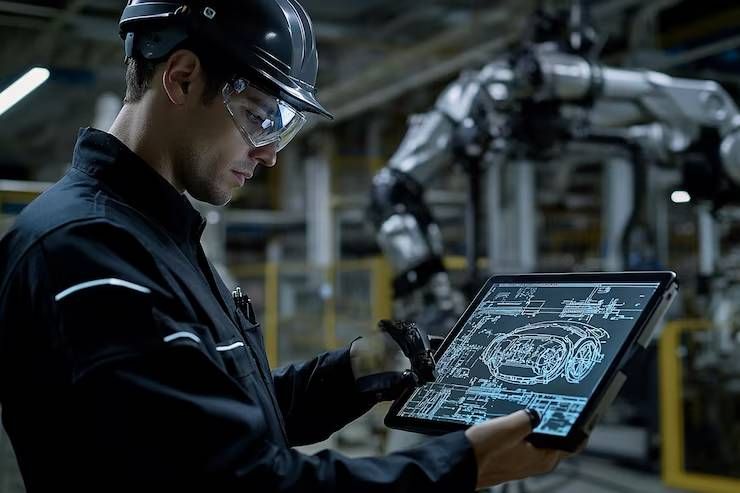
Traditional maintenance methods generally follow three approaches. Reactive maintenance takes place after equipment fails, preventive maintenance follows a planned schedule, and predictive maintenance uses information about actual equipment conditions to help determine when maintenance may be needed. AI can support predictive maintenance by analyzing large amounts of operational information that would be difficult to examine manually.
The concept developed from earlier condition-monitoring practices, including vibration analysis, temperature measurement, oil analysis, and mechanical inspection. As computers, industrial sensors, and data-processing systems advanced, organizations gained more ways to collect and analyze equipment information. Machine learning extended these methods by allowing software to identify relationships in historical and real-time data.
How AI Predictive Maintenance Works
AI predictive maintenance typically follows a sequence of data collection, analysis, fault identification, and maintenance planning. Sensors installed on equipment may measure vibration, temperature, pressure, electrical current, rotational speed, or sound. The collected information is then examined by analytical models that look for patterns associated with normal operation or possible faults.
A model may compare current measurements with historical records from the same machine or similar equipment. When unusual patterns appear, the system can generate an alert for inspection. Maintenance personnel can then examine the equipment and determine whether a repair, adjustment, or additional test is necessary.
The main stages commonly include:
- Data collection through sensors, control systems, and inspection records.
- Data preparation to correct missing, inconsistent, or inaccurate measurements.
- Model development using historical operating information and known equipment faults.
- Condition monitoring to identify unusual patterns during operation.
- Maintenance planning based on alerts, inspections, equipment importance, and available resources.
Common Types of AI Models
Machine learning models can support different predictive maintenance tasks. Classification models identify possible fault categories, while regression models estimate numerical values such as remaining useful life or expected vibration levels. Anomaly detection models identify patterns that differ from normal operating behavior.
Deep learning models can examine complex data from vibration signals, acoustic measurements, images, and other sources. The appropriate model depends on the machine, available data, type of fault, and purpose of the analysis.
Importance
AI in predictive maintenance matters because equipment failures can interrupt production, affect product quality, create safety hazards, and disrupt the movement of goods. A failed pump may interrupt water circulation, while a damaged motor can stop a production line. In transportation and energy systems, equipment problems may also affect reliability and public safety.
Predictive maintenance provides a way to examine equipment conditions rather than relying entirely on fixed maintenance intervals. AI can help identify patterns that may be associated with wear, overheating, imbalance, misalignment, or other developing problems. However, predictions remain estimates and must be interpreted alongside inspections and engineering knowledge.
Applications Across Industries
Manufacturing facilities use AI predictive maintenance to monitor motors, conveyors, machine tools, robotic systems, compressors, and industrial pumps. Detecting unusual vibration or rising temperature may help identify a developing mechanical problem before a major breakdown occurs.
Energy facilities can apply similar techniques to turbines, generators, transformers, and other critical equipment. Transportation operators may analyze information from vehicle engines, rail components, and aircraft systems, subject to the specific safety and regulatory requirements of each sector.
Water treatment facilities can monitor pumps and motors, while warehouses can examine conveyor systems and automated material-handling equipment. These applications show that predictive maintenance is relevant wherever equipment condition affects continuity, reliability, or safety.
Benefits and Practical Limitations
AI-supported maintenance can help organizations identify developing faults, prioritize inspections, plan maintenance activities, and understand recurring equipment problems. It may also help reduce unnecessary inspections when condition data provides a reliable basis for planning.
Nevertheless, several limitations affect its use:
- Poor-quality sensor data can produce misleading results.
- Rare equipment failures may leave too little historical data for model training.
- Changes in machine loads or operating environments can reduce prediction accuracy.
- Sensors, network connections, data storage, and trained personnel require ongoing resources.
- False alarms may lead to unnecessary inspections, while missed warnings can delay intervention.
- Some systems are difficult to interpret, making human review important.
AI therefore supports maintenance decisions rather than replacing physical inspection, technical judgment, or established safety procedures.
Predictive Maintenance Compared with Other Approaches
| Maintenance approach | When maintenance occurs | Role of AI |
|---|---|---|
| Reactive maintenance | After a failure | May help analyze failure records |
| Preventive maintenance | At planned intervals | May help adjust maintenance schedules |
| Condition-based maintenance | When measured conditions indicate a need | Can interpret sensor measurements |
| Predictive maintenance | Based on estimated future equipment condition | Can identify patterns and estimate potential faults |
Recent Updates
From 2024 through 2026, AI predictive maintenance has continued to develop alongside industrial automation, connected sensors, cloud computing, and edge computing. The general direction is toward combining equipment monitoring with broader production data, rather than analyzing individual sensor readings in isolation.
Edge AI and Real-Time Monitoring
Edge AI processes data close to the equipment instead of sending every measurement to a remote platform. This can reduce communication delays and limit the amount of information transferred across a network. It is particularly useful where machines operate in locations with limited connectivity or require rapid detection of unusual conditions.
Cloud-based systems remain relevant for storing historical records, comparing equipment across facilities, and training analytical models. Some industrial environments combine edge processing with cloud analysis to balance response time and computing requirements.
Digital Twins and Equipment Simulation
A digital twin is a digital representation of a physical machine or system that can be updated with operational data. In predictive maintenance, a digital twin may combine sensor measurements, engineering models, and historical performance information to examine how equipment behaves under different conditions.
AI can help analyze these data and identify differences between expected and observed behavior. However, the quality of a digital twin depends on its design, input data, and how closely the model represents the actual equipment.
Generative AI and Maintenance Information
Generative AI is increasingly being explored for searching technical manuals, summarizing inspection reports, organizing maintenance records, and helping technicians locate relevant information. When connected to properly managed documents, these systems may make equipment information easier to interpret.
Generative AI can also produce incorrect or unsupported answers. Maintenance decisions involving machinery safety must therefore rely on verified technical documentation, approved procedures, and qualified personnel rather than unverified AI-generated instructions.
Cybersecurity and Data Quality
As industrial equipment becomes more connected, organizations are paying greater attention to data integrity and cybersecurity. Unauthorized changes to sensor data or control systems can affect monitoring results and operational safety.
Current development efforts commonly emphasize secure access, network separation, reliable sensor calibration, model monitoring, and protection of industrial records. These measures are important because a predictive system is only useful when its inputs and outputs can be trusted.
Laws or Policies
AI predictive maintenance is affected by workplace safety rules, machinery regulations, data protection requirements, cybersecurity practices, and industry-specific standards. The exact obligations depend on the country, type of equipment, and operational environment. AI predictions do not remove existing responsibilities for safe equipment operation.
Regulations Relevant to India
In India, industrial machinery and maintenance activities may fall under applicable occupational safety, factory, electrical safety, environmental, and sector-specific requirements. The Occupational Safety, Health and Working Conditions Code, 2020, forms part of India's labour law framework; its application depends on the provisions in force and the relevant implementing rules.
The Ministry of Electronics and Information Technology publishes information on India's digital and technology policies. The Digital Personal Data Protection Act, 2023, and associated rules may be relevant when predictive maintenance systems process personal data, such as identifiable worker information. Equipment telemetry alone is not necessarily personal data.
Organizations operating critical infrastructure or connected industrial systems may also need to consider applicable cybersecurity directions and sector-specific requirements. Requirements for power, railways, aviation, and other regulated industries can differ substantially.
Standards and Safety Responsibilities
International standards can help organizations structure their maintenance and machinery-safety practices. ISO 17359 provides general guidance on condition monitoring and diagnostics of machines, while ISO 13374 addresses data processing, communication, and presentation for machine condition monitoring.
Standards do not automatically replace local legal requirements. Equipment operators remain responsible for appropriate inspections, safe work procedures, personnel training, and required maintenance records. AI-generated alerts should be evaluated within the applicable safety-management framework.
Tools and Resources
Several technical resources help explain and implement AI predictive maintenance. Their suitability depends on equipment type, data availability, system compatibility, and the user's technical requirements.
- Condition-monitoring instruments: Vibration analyzers, thermal cameras, acoustic sensors, and electrical measurement devices collect information about equipment condition.
- Industrial control systems: Programmable logic controllers and supervisory control and data acquisition systems can provide operational measurements and equipment status information.
- Data analysis tools: Python libraries such as pandas and scikit-learn support data preparation, machine learning, classification, and anomaly detection.
- Industrial IoT platforms: These systems collect equipment data, organize sensor information, and support monitoring dashboards and alerts.
- Maintenance management software: Computerized maintenance management systems organize work orders, inspection records, spare-parts information, and maintenance histories.
- Technical standards: ISO publications and relevant national standards provide background on condition monitoring, machine diagnostics, and equipment safety.
Useful reference sources include the International Organization for Standardization, the Bureau of Indian Standards, India's Ministry of Labour and Employment, and the Ministry of Electronics and Information Technology. Their publications help readers understand applicable standards, regulatory frameworks, and technical terminology.
FAQs
What is AI in predictive maintenance?
AI in predictive maintenance uses machine learning and equipment data to identify unusual operating patterns and estimate potential faults. The results help maintenance teams assess equipment conditions and plan inspections.
How does AI predict machine failure?
AI models analyze measurements such as vibration, temperature, pressure, and electrical current. They compare current patterns with historical data or learned operating behavior to identify warning signs associated with possible faults.
What are the main benefits of AI predictive maintenance?
Potential benefits include earlier fault identification, more informed maintenance planning, improved visibility into equipment conditions, and analysis of recurring failures. Results depend on data quality, model accuracy, and appropriate human oversight.
Which industries use AI predictive maintenance?
Manufacturing, energy, transportation, water treatment, mining, and logistics are among the sectors that use or investigate AI-supported equipment monitoring. Applications vary according to machinery, operational risks, and regulatory requirements.
Is AI predictive maintenance accurate?
Accuracy varies with the available data, type of equipment, fault frequency, model design, and operating conditions. False alarms and missed faults remain possible, so predictions generally need to be checked against inspections and other evidence.
Conclusion
AI in predictive maintenance combines machine learning, sensor data, and equipment monitoring to estimate potential faults and support maintenance planning. Its applications span manufacturing, energy, transportation, water systems, and other industrial sectors. Developments in edge AI, digital twins, and generative AI are expanding how equipment information is collected and interpreted. Data quality, cybersecurity, regulatory compliance, and human oversight remain important parts of reliable maintenance practices.