
Automated extrusion production lines are industrial systems that transform raw materials into continuous products with a consistent cross-sectional shape. These systems use specialized machinery, temperature controls, sensors, and automated handling equipment to manufacture products such as plastic pipes, profiles, films, sheets, rubber components, and metal sections.
Extrusion is widely used because it can produce long lengths of material with a uniform profile. Automation connects the individual stages of production, helping equipment maintain operating conditions and coordinate material feeding, shaping, cooling, cutting, and product handling.
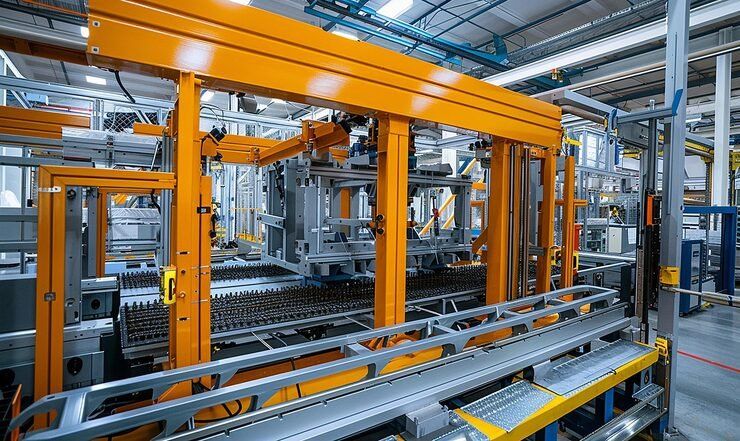
An automated extrusion line may contain a material feeder, an extruder, a die, a cooling system, a haul-off unit, a cutting machine, and a collection or packaging system. The exact arrangement depends on the material being processed, the product dimensions, and the required production characteristics.
How extrusion technology works
Extrusion generally involves forcing a material through a specially shaped opening called a die. The material emerges with a cross-section determined largely by the die geometry and the conditions maintained during processing.
In plastic extrusion, polymer granules or pellets typically enter a heated barrel, where a rotating screw moves, mixes, and melts the material. The molten polymer is pushed through the die and then cooled to maintain the required shape.
Other extrusion processes use different material preparation and forming methods. Rubber extrusion may involve temperature-controlled processing followed by vulcanization, while metal extrusion commonly uses high pressure to force a billet through a die. These processes share the principle of continuous forming but differ significantly in machinery, temperatures, forces, and material behavior.
Main stages of an automated extrusion line
A typical automated production line includes several connected stages:
Material feeding: Supplies raw material to the processing equipment at a controlled rate.
Extrusion: Moves and shapes the material through the barrel, screw, and die or equivalent forming mechanism.
Calibration and cooling: Helps maintain dimensions and stabilize the product after it leaves the die.
Haul-off: Pulls the extruded product through the line at a controlled speed.
Cutting or winding: Produces specified lengths or winds continuous material into rolls.
Inspection and collection: Checks selected product characteristics and transfers finished output for subsequent handling.
Coordination between these stages is essential. If the extruder produces material faster than the downstream equipment can handle it, the product may stretch, accumulate, or become dimensionally inconsistent.
Importance of Automated Extrusion Production Lines
Automated extrusion production lines are important in manufacturing because many industries require large quantities of products with repeatable dimensions and material properties. Manual coordination of every production stage can be difficult when processing speeds, temperatures, and product dimensions must remain within defined limits.
Automation helps coordinate machine operation and provides information about production conditions. Sensors can measure temperatures, pressures, line speeds, and other variables, while control systems adjust equipment settings within configured operating limits.
Benefits for industrial production
The main operational benefits depend on the production process, equipment design, and quality-control arrangements.
Process consistency: Automated controls help maintain selected temperatures, screw speeds, and haul-off speeds.
Production coordination: Connected equipment can synchronize feeding, extrusion, cooling, and cutting.
Material monitoring: Weighing and feeding systems can track material consumption and help identify variations.
Product traceability: Digital records can associate production conditions with specific batches or production runs.
Reduced manual handling: Automated cutting, winding, and conveying can limit repetitive material handling.
Fault detection: Sensors and alarms can identify abnormal conditions that require operator attention.
Automation does not eliminate defects or remove the need for skilled operators. Incorrect settings, worn components, unsuitable raw materials, and poor maintenance can still affect production quality.
Industries that use extrusion production lines
Automated extrusion systems are used in a broad range of manufacturing sectors.
Plastics manufacturing: Produces pipes, tubing, window profiles, sheets, films, cable insulation, and plastic components.
Packaging: Manufactures packaging films, protective sheets, and selected polymer-based packaging materials.
Construction: Produces plastic drainage pipes, electrical conduits, weather seals, building profiles, and insulation-related components.
Automotive manufacturing: Produces seals, trim profiles, hoses, polymer tubing, and selected lightweight components.
Electrical manufacturing: Uses extrusion to produce cable insulation and protective sheathing.
Food processing: Uses specialized extrusion equipment to manufacture certain cereals, snacks, pasta, and pet food products. These lines use different material-handling and cooking arrangements from conventional plastic extrusion systems.
Metal manufacturing: Uses metal extrusion presses to produce aluminum profiles, rods, bars, and other shaped sections.
The equipment configuration varies substantially across these applications. A plastic pipe line, for example, requires different tooling, cooling, and calibration arrangements from a food extrusion line or an aluminum extrusion press.
Recent Developments in Extrusion Automation
Extrusion technology continues to evolve through improvements in digital controls, process monitoring, energy management, and production-line integration. Developments during 2024–2026 reflect growing interest in more precise process control, automated inspection, material traceability, and data-driven manufacturing.
Smart controls and industrial connectivity
Modern extrusion lines may use programmable logic controllers (PLCs), human-machine interfaces (HMIs), and supervisory control and data acquisition (SCADA) systems. These technologies allow operators to monitor equipment conditions, adjust process parameters, and review alarms from centralized control stations.
Connected manufacturing systems can also record production information, including operating temperatures, material feed rates, line speeds, and equipment interruptions. When integrated with manufacturing execution systems (MES), this information can support production scheduling, batch tracking, and quality reporting.
AI-assisted monitoring and predictive maintenance
Some manufacturers are exploring artificial intelligence (AI) and machine-learning techniques to identify patterns in production data. These tools can help detect unusual pressure changes, temperature variations, motor behavior, or other conditions associated with process disturbances.
Predictive maintenance systems analyze equipment information to identify possible signs of wear or deterioration. Their accuracy depends on sensor quality, historical records, and the suitability of the analytical model. Maintenance decisions still require technical judgment and appropriate inspections.
Automated quality inspection
Machine vision and laser measurement systems can inspect product dimensions and surface characteristics during production. Depending on the application, these systems may identify irregular profiles, surface defects, dimensional deviations, or inconsistent product markings.
Automated inspection can provide more frequent measurements than occasional manual checks. However, inspection systems must be configured for the material and defect types involved, and their results may require confirmation through established testing procedures.
Energy and material efficiency
Manufacturers are also examining energy use, material waste, and recycled feedstocks. Improved temperature regulation, optimized motor drives, and coordinated line speeds can help reduce unnecessary energy consumption when correctly implemented.
Processing recycled polymers introduces additional challenges because material composition, moisture, contamination, and melt characteristics can vary. Consistent feeding, filtration, drying, and process monitoring are therefore important in applications using recycled materials.
Laws, Standards, and Regulatory Considerations
Automated extrusion production lines must comply with applicable requirements covering machinery safety, electrical systems, worker protection, environmental performance, and product quality. The exact obligations depend on the country, the type of extrusion process, the materials involved, and the final product.
Regulatory considerations in India
Manufacturing facilities in India must consider applicable occupational safety, factory, electrical safety, and environmental requirements. The Occupational Safety, Health and Working Conditions Code, 2020, forms part of the country's labour-law framework, with obligations depending on the relevant commencement provisions and implementing rules.
Factories may also need to follow applicable state-level requirements, pollution-control conditions, and rules governing emissions or industrial waste. Plastic extrusion operations that generate process waste or use particular additives may be subject to additional environmental requirements.
For machinery incorporating automated controls, guarding, emergency stops, electrical protection, and safe maintenance procedures are important considerations. Applicable Indian standards and regulatory requirements should be identified according to the machine type and intended application.
International machinery and quality standards
Several international standards and technical frameworks are relevant to extrusion equipment and automated production.
ISO 12100: Provides principles for machinery risk assessment and risk reduction.
IEC 60204-1: Addresses electrical equipment of machines.
ISO 13849-1: Covers safety-related parts of control systems.
ISO 9001: Establishes requirements for quality management systems.
IEC 61131: Covers programmable controllers used in industrial automation.
These standards have different scopes and legal status. Their use may be required by a regulation, contract, customer specification, or applicable conformity process, or they may be adopted as part of an organization's internal engineering practices.
Product-specific requirements
Products made on extrusion lines may have additional specifications relating to dimensions, mechanical properties, chemical composition, fire performance, food contact, or electrical insulation. For example, a pipe used in a particular application may need to meet product-specific testing requirements that do not apply to a decorative plastic profile.
Manufacturers must therefore consider both the safety of the production equipment and the technical requirements of the finished product.
Equipment, Software, and Technical Resources
Planning an automated extrusion line involves evaluating the raw material, die design, production rate, downstream equipment, control architecture, and finished-product specifications. Engineers use different tools to design the process, monitor operating conditions, and maintain consistent output.
Common equipment in extrusion production
Equipment | Main function |
|---|---|
Material feeder | Delivers raw material at a controlled rate |
Extruder or extrusion press | Forms material by forcing it through a die |
Die and tooling | Determines the product's cross-sectional shape |
Temperature controller | Maintains selected heating and cooling conditions |
Vacuum calibration system | Helps maintain dimensions in suitable plastic profile and pipe lines |
Cooling tank or cooling unit | Stabilizes the product after forming |
Haul-off unit | Controls the movement and speed of the extruded product |
Cutter or winding unit | Cuts products to length or collects continuous material |
Inspection system | Measures selected product dimensions or detects defects |
PLC and HMI | Coordinate equipment and provide operator controls |
Not every line uses all these components. Metal extrusion presses, food extrusion systems, rubber processing lines, and plastic film production equipment require different arrangements.
Software used in extrusion automation
PLC programming software: Configures machine sequences, sensor inputs, motor controls, alarms, and interlocks.
SCADA systems: Provide centralized monitoring of production equipment and process variables.
Manufacturing execution systems: Record production activity, material batches, work orders, and quality information.
Computer-aided design (CAD): Supports the design of dies, tooling, machine parts, and product profiles.
Simulation and process analysis software: Helps engineers examine material flow, die behavior, thermal conditions, and production parameters.
Maintenance management software: Organizes equipment inspections, maintenance records, spare-part tracking, and planned repairs.
Global manufacturers and equipment suppliers
The industrial extrusion market includes companies specializing in extrusion machinery, automation controls, tooling, and downstream equipment. Examples of established industrial equipment manufacturers include KraussMaffei, Coperion, Reifenhäuser, Davis-Standard, and Bühler. Their product portfolios differ, and their involvement in a particular application depends on the material and production technology.
Other companies manufacture automation components, drives, sensors, temperature controllers, and industrial software that may be integrated into extrusion lines. Selecting equipment requires checking technical compatibility, production requirements, maintenance arrangements, and applicable safety standards rather than relying on company names alone.
Factors to evaluate when planning a production line
A technical assessment generally considers:
Raw material type, grade, and processing characteristics.
Required product shape, dimensions, and tolerances.
Expected throughput and operating schedule.
Die design and downstream equipment compatibility.
Temperature, pressure, and motor-control requirements.
Inspection methods and production traceability.
Operator training, maintenance access, and safety controls.
Energy use, material recovery, and waste management.
These factors influence the line's design and its ability to maintain consistent operating conditions over time.
Frequently Asked Questions
What is an automated extrusion production line?
It is a connected system of machines and controls that forms raw material into continuous products, then cools, measures, cuts, winds, or otherwise handles the output with limited manual coordination.
What products are made using extrusion technology?
Extrusion is used to manufacture plastic pipes, films, sheets, profiles, cable insulation, rubber seals, aluminum sections, and certain food products. The process and equipment depend on the material being formed.
How does automation improve extrusion production?
Automation coordinates material feeding, temperature regulation, screw or press operation, product movement, and downstream handling. Sensors and inspection systems can also help operators identify process variations and maintain production records.
What is the role of PLC and SCADA systems in extrusion lines?
A PLC executes programmed machine-control functions, while SCADA provides broader monitoring, visualization, and data collection. Together, they can help coordinate equipment and make operating conditions easier to observe.
What factors influence extrusion line selection?
Important factors include material properties, product geometry, required output, die design, cooling requirements, measurement tolerances, equipment compatibility, and applicable safety standards.
Conclusion
Automated extrusion production lines combine forming machinery, material handling, temperature regulation, downstream equipment, and digital controls to manufacture continuous products. Their configurations vary across plastics, rubber, metals, and food processing, with each application requiring appropriate tooling and operating conditions. Modern automation supports process monitoring, quality inspection, traceability, and equipment maintenance. Reliable production depends on suitable engineering, trained operators, effective maintenance, and compliance with relevant technical requirements.